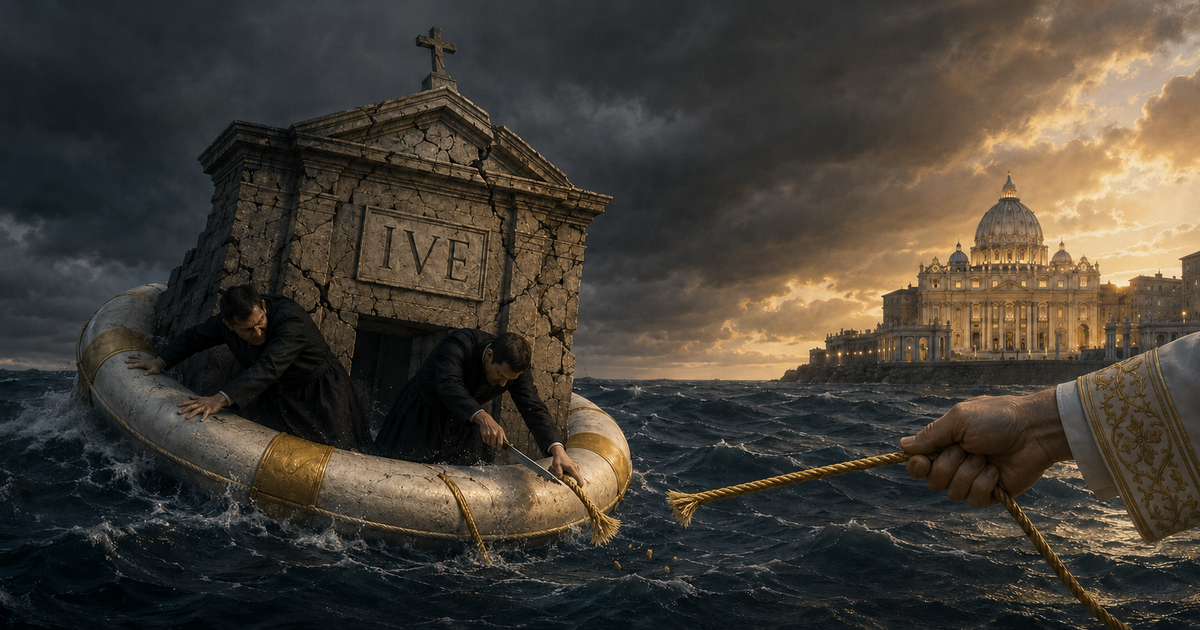
The IVE presents Rome’s measures as persecution. The chronology shows exactly the opposite: since 1995, the Church has invested authorities, specialists and external structures to sustain and reform an institution that has not been able to correct itself.
Some time ago we published an article on this blog entitled “Institute of the Incarnate Word: too big to fail?”. The expression, borrowed from the financial world, is applied to those institutions whose size is such that their collapse could cause even greater damage than that caused by their mismanagement. For this reason, although they are deeply deteriorated, the authorities are forced to intervene, inject resources and sustain them to avoid an uncontrolled collapse.
The question we posed then was whether the Institute of the Incarnate Word (IVE) and the Servants of the Lord and of the Virgin of Matará (SSVM) had come to occupy a similar position within the Church: a religious family too large, too extended and too intertwined with dioceses, parishes, seminaries, schools and apostolic works for the Holy See to simply let it fall.
Recent events do not weaken that hypothesis. On the contrary, they seem to confirm it.
In summary
- The IVE is going through its sixth phase of extraordinary pontifical government since 1995.
- Rome has for three decades assigned commissioners, delegates, canonists, formators and external authorities to try to reform it.
- Other communities with governance problems or abuses were permanently suppressed; the IVE receives, on the other hand, a rescue operation proportional to the consequences that its fall would have.
- To call this extraordinary guardianship “persecution” inverts reality: the Church is protecting the members, works and dioceses that would suffer a disorderly collapse.
Intervention is the rescue
In the economic realm, declaring an entity to be too big to fail does not mean that it is too powerful to be supervised. It means that its failure would force the authority to devote extraordinary resources to sustain it, reorganize it and prevent its collapse from harming third parties.
That is precisely what is happening with the IVE.
The Holy See has not limited itself to appointing a visitor, writing a report or formulating some recommendations. He has entrusted Monsignor José Antonio Satué with all the powers of government of the Institute. The pontifical delegate has set up a new team to cover the essential areas of institutional life: government, economy, formation, procurement, monasteries, documentation and administration.
The composition of that team is especially revealing. If the delegate himself is included, six of the eight people who make up the new governance structure come from outside the IVE. Rome has had to resort to religious from other congregations, a lay canonist and external collaborators to provide the Institute with the governing capacities that it does not seem to be able to guarantee on its own.
This is not a purely punitive sanction. We are facing the creation of a rescue structure.
Not the first bailout: three decades of pontifical tutelage
The current intervention might seem like an exceptional response to recently discovered problems. History shows otherwise. The IVE has spent a good part of its existence under some form of surveillance, tutelage or extraordinary government of the Holy See.
The terminology has not always been the same. At different times the figures of pontifical commissioner, pontifical delegate, pontifical assistant, visitors or authorities designated to preside over a General Chapter appear. Not all of these functions are legally identical. That is why some publications speak of five curators and others of six interventions. The chronology allows us to clarify the apparent contradiction.
1. José Antonio Rico, OSB — 1995–1998
On September 19, 1995, the Congregation for Institutes of Consecrated Life appointed the Spanish Benedictine José Antonio Rico as the first pontifical commissioner of the IVE. The historical chronology itself disseminated by the Institute’s environment records the appointment. During his term of office, Rico approved ad experimentum the constitutions of the IVE, on May 3, 1997. The intervention, therefore, did not only have a disciplinary function: it provided the young institute with a legal framework that it had not yet managed to consolidate by its own means.
2. Aurelio Londoño, CM — 1998–1999
In 1998, Rico was succeeded by Colombian Vincentian Aurelio Londoño. The information published during the crisis of 2000 expressly identifies both as pontifical commissioners. The immediate succession of a second external delegate shows that the tutelage did not end with the first constitutional regularization.
3. Alfonso Delgado Evers — 1999–2001
The third commissioner was Monsignor Alfonso Delgado Evers, then bishop of Posadas and later archbishop of San Juan de Cuyo. His status as pontifical commissioner of the IVE appears in the biography published by the archdiocese itself. During this stage, Rome ordered the closure of the three male formation centers of the Institute in San Rafael: the major seminary, the minor seminary and the novitiate. Delgado explained that the provisions had been taken in communion with John Paul II and were intended to solve problems of obedience and ecclesial communion that were not new, but dated back to the origins of the Institute.
4. Domingo Salvador Castagna and Alfredo Horacio Zecca — 2010
In 2010 a new phase was opened. Monsignor Domingo Salvador Castagna, archbishop emeritus of Corrientes, took over as commissioner and asked for the collaboration of Monsignor Alfredo Horacio Zecca as deputy commissioner. Some contemporary sources initially described them as visitors or overseers, while later reconstructions of the intervention identify them as commissioner and deputy commissioner. This terminological difference explains part of the discrepancies in the count.
The intervention responded, among other factors, to the high number of priests who asked to leave the Institute, to the problems of government and to the complaints against Carlos Buela. That same year, the Holy See removed the founder from the government, considered the accusations of improper conduct credible, and imposed restrictions on his residence and contact with members of the IVE.
5. The intervention of the General Chapter — 2015–2019
This stage must be counted as a pontifical intervention, but not as an independent commissariat in the strict sense.
In December 2015, the Holy See announced that it would assume the direction of the 2016 General Chapter. Cardinal Francesco Coccopalmerio was sent to preside over it, accompanied by Monsignor Vito Angelo Todisco and the Dominican Philippe Toxé. Rome also reserved the appointment of the vicar general and two councillors of the new government. On October 4, 2016, Todisco was appointed pontifical assistant to accompany and supervise the superior general and his council.
The entire government was not immediately dismissed and replaced by a single commissar. But there was no longer an ordinary autonomous government either: the Chapter was directed from the outside, part of the Council was appointed by the Holy See and a pontifical assistant was incorporated into the institutional functioning.
6. Cardinal Santos Abril y Castelló — 2019–2025
The problems of government and training persisted. The pontifical decree of December 2024 precisely establishes that on June 10, 2019, Cardinal Santos Abril y Castelló was appointed pontifical commissioner of the IVE. His appointment responded to the need to entrust the direction again to an external personality endowed with extensive experience and moral authority.
During his term of office, the circumscriptions were reviewed, provincial superiors were appointed and general statistics of the Institute were compiled. The commissariat found serious weaknesses in formation, communities composed of only two isolated religious or priests, and a historical loss of close to 40% of the members. Abril also constituted the special court that in 2021 declared proven that Buela had committed crimes against the sixth commandment with violence against five members or former members of the IVE.
After several years, the cardinal and his council concluded that there was still a lack of collaboration from superiors and a general resistance to the changes demanded by the Church.
7. José Antonio Satué — from 2025
The decree was signed on December 8, 2024, and the appointment was made public in January 2025. Monsignor José Antonio Satué received the title of pontifical delegate, with all the powers of government and the faculty to repeal the constitutions of the Institute when he considered it necessary. His mission expressly succeeds the commissariat of Cardinal Abril. By 2026 it has established a mostly external government and communications infrastructure independent of the old IVE systems.
Fifth, sixth or seventh?
The answer depends on what is being told:
- If we count the successive phases of commissariat or extraordinary pontifical government – Rico, Londoño, Delgado, Castagna/Zecca, Abril and Satué – the current one is the sixth.
- If we count Castagna and Zecca individually, seven people appear in these six phases.
- If we add the special intervention of 2015–2019, with Coccopalmerio, Todisco and Toxé, we get seven interventions, but it would be inaccurate to call all of them pontifical commissioners.
The most rigorous formulation for this article is, therefore: the IVE is going through its sixth phase of extraordinary pontifical government, in addition to having been the subject of a special intervention by its Chapter and its General Council between 2015 and 2019.
This data changes the perspective. We are not dealing with an institution that has received a single correction and deserves another chance. We are dealing with an institution to which the Holy See has been trying to provide governance, canonical form, supervision and possibilities for reform since 1995.
Resources that the Church must deduct from other needs
The universal Church faces hundreds of more serious and urgent problems: wars, persecutions, vocation crises, sexual abuse, bankrupt dioceses, secularization, internal conflicts and a general loss of credibility. Its human resources are limited. The time of a bishop, of the heads of a dicastery, of canonists, treasurers, formators and religious superiors is not unlimited or free.
However, a part of these resources must be allocated to the IVE.
Monsignor Satué has not simply been charged with observing the situation. He must govern a problematic international institution while continuing to be bishop of Malaga. Other religious, belonging to congregations that have their own works and needs, must assume tasks of economy, formation, law and administration within an external institute. The competent Dicastery must oversee appointments, study decisions and accompany a process that has already consumed the Holy See’s time and energy for years.
That institutional cost is the ecclesial equivalent of a financial bailout. It does not take the form of a transfer of billions, but of something that for the Church may be even more scarce: competent people, authority, time, attention and capacity for government.
Rome has had to rebuild even the basic instruments of government
The gravity of the situation is even better perceived in the measures taken on the Institute’s communications.
The pontifical delegate reported that, after consulting the provincials and the councilors of the General Government, he had not been able to determine who administered the official page ive.org or the corporate accounts ending in @ive.org. He rightly considered that it would be irresponsible to continue to depend on an infrastructure whose administrators could not be identified by the authority in charge of governing the Institute.
The response was extraordinary. The old website is no longer recognized as an official page. verboencarnado.org was created as the only authorized institutional site and it was decided to replace the old email accounts with new @verboencarnado.org addresses, technically managed from outside the IVE structure.
That is, Rome has not only had to provide the Institute with a government. It has also had to build the technical instruments that allow that government to really exercise its authority, communicate with members and receive information with guarantees of security and privacy.
Even the computer scientist of a diocese must dedicate his work to reconstructing the basic channels of communication of an intervened international congregation.
How could all this be seen as proof that the abortion is being abandoned or destroyed? What is observed is exactly the opposite: an external authority is investing its own resources to prevent internal opacity and resistance from making the governance of the Institute unviable.
The paradox of “persecution”
And yet, within the IVE and its entourage, there is still talk of persecution.
The narrative is known: Rome would not understand charisma; the ecclesiastical authorities would be hostile to a young, missionary and traditional congregation; pontifical measures would constitute an unjust punishment against religious faithful; intervention would be an external aggression against a fruitful work.
This interpretation completely inverts reality.
A persecuted institution is unjustly deprived of its rights or destroyed by a hostile authority. A rescued institution, on the other hand, receives from the outside the means it needs to continue to exist despite having lost the ability to govern itself normally.
The IVE is not being left to its fate. The Church is making available to them a bishop, a governance team, external specialists, administrative structures and new communication systems. It is trying to preserve its members, its works and its mission, preventing the consequences of decades of expansion, opacity, disobedience and mismanagement from falling indiscriminately on priests, seminarians, nuns, faithful and dioceses.
To present all this as persecution is not only a misinterpretation. It is a form of institutional ingratitude.
The privilege of being rescued
Many small congregations would not receive such an effort. If a community with few members were incapable of governing itself, withheld information from authority, accumulated complaints and needed Rome to rebuild its governing bodies and communications from the outside, it would probably be suppressed or led to an orderly disappearance.
The abortion receives other treatment precisely because it is not a small community. Its international presence, the number of its members and the number of works it administers mean that an immediate dissolution could harm too many people and institutions that are not responsible for its governance problems.
That’s the true meaning of too big to fail.
It does not mean that the IVE has defeated Rome. Nor does it mean that his superiors have demonstrated the solidity of his model. It means that the cost of its failure would be borne by seminarians, priests, nuns, students, families, parishes and dioceses spread across many countries. To protect those people and avoid a chaotic collapse, the Holy See is forced to sustain and reorganize the institution.
The expansion, which for decades was presented as indisputable proof of divine blessing, has thus become the main practical argument to justify an extraordinary rescue.
The Church has suppressed other communities
We are not formulating an abstract hypothesis. In recent years, the ecclesiastical authority has decreed the definitive closure of communities that it judged incapable of correcting their problems or whose continuity it considered harmful.
It is worth making a canonical clarification: not all of them were technically “religious congregations”. These included a religious institute, a society of apostolic life, new communities, and public or private associations of the faithful. But they were all officially recognized ecclesial realities and all lost that juridical existence by decision of the authority of the Church.
1. The Integrated Catholic Community — Germany, 2020
On November 20, 2020, Cardinal Reinhard Marx dissolved the Katholische Integrierte Gemeinde, a public ecclesial association erected in the archdiocese of Munich and Freising in 1986. The decision came after a visit that began in 2019. The visitors described problems rooted in the pretensions and in the very structure of the community, in addition to the lack of cooperation of its leaders. By then, the association already lacked governing bodies and recognized members.
2. Totus Tuus New Evangelization — Germany, 2021
On 4 November 2021, the Bishop of Münster decreed the dissolution of Totus Tuus Neuevangelisierung, a private association of the faithful with 135 members. The investigation had detected spiritual abuses, confusion between government and spiritual accompaniment, a style of leadership focused on certain people, elitism and spiritual disqualification of criticism. The authority concluded that those responsible were neither willing nor able to recognize and correct the deficiencies. The appeal filed by the community was rejected and the Roman Dicastery confirmed the dissolution in July 2022.
3. The Community of the Word of Life — Belgium and France, 2023
Cardinal Jozef De Kesel decreed in June 2022 the dissolution of the Community of the Word of Life, which became effective on July 1, 2023. A first canonical visitation had pointed out problems in 2002. Twenty years later, a second visit confirmed the persistence of difficulties in governing, respecting people and defining one’s charism. Over thirty years there had been about 240 abandonments. The authority considered that the available human forces were insufficient to carry out a true reform and chose to close the community and accompany its members individually.
4. The Loyola Community — Slovenia, 2023
On October 20, 2023, the Dicastery for Institutes of Consecrated Life decreed the dissolution of the Loyola Community, a women’s community co-founded by Father Marko Rupnik. The decree pointed out serious problems in the exercise of authority and in common life and established a period of one year to execute the closure. The decision was taken in the context of numerous testimonies about spiritual, psychological and sexual abuse linked to the founder and the functioning of the community.
5. Miles Christi — Argentina, 2025
On February 19, 2025, the Dicastery for Institutes of Consecrated Life and Societies of Apostolic Life decreed the suppression of Miles Christi, a clerical religious institute of diocesan right founded in Argentina. The decision had been specifically approved by Pope Francis on Feb. 6. The institute had been under pontifical intervention since 2022. Rome did not prolong the tutelage indefinitely: it concluded the commissariat and appointed a delegate to execute the suppression.
6. The Sodalitium of Christian Life and its branches — Peru, 2025
In April 2025, the Vatican formalized the suppression of the Sodalitium of Christian Life, a society of apostolic life of pontifical right, along with the other institutions founded by Luis Fernando Figari: the Marian Fraternity of Reconciliation, the Servants of God’s Plan and the Christian Life Movement. The decision followed an investigation ordered by Pope Francis into sexual, spiritual and authority abuse, violence, cover-up and economic corruption. In this case, not only a small local association was suppressed, but an entire ecclesial family with an international presence.
These precedents demonstrate two things. First, that suppression is not a merely theoretical possibility: the Church has used it repeatedly and for various reasons, from spiritual abuses and misgovernment to the inability to reform. Second, that Rome does not consider it obligatory to preserve indefinitely any work that has received canonical recognition.
That is why the contrast with the IVE is so significant. Faced with other communities, the authority concluded that the resources necessary to reform them were insufficient or that the damage made their continuity inadvisable. Before the IVE, on the other hand, he has been appointing visitors, commissioners, delegates, advisors and external teams for years; reorganizing the government; and even creating a new communications infrastructure.
The most plausible explanation is not that the problems of abortion are less serious. The consequences of a suppression would be incomparably more difficult to administer.
From guardianship to accountability
Acknowledging that intervention constitutes a rescue does not mean saying that everything is solved. Saving an institution from collapse is not equivalent to repairing the damage caused or doing justice to the victims.
Recent documents spell out who governs, what responsibilities each contributor will have, and how communications will be reorganized. But they still do not provide sufficient public information on complaints, investigations conducted, personal and institutional responsibilities, whistleblower protection, or remedial measures.
Rescue may be necessary, but it must not turn into impunity.
The Holy See should not limit itself to ensuring that the IVE continues to function. It must ensure that the institution tells the truth about its past, protects those who have suffered abuse, purifies responsibilities and definitively abandons the structures and narratives that made intervention necessary.
Otherwise, the cost of the bailout will be borne by the whole Church while those who caused the crisis continue to present themselves as victims.
Too big to drop
Today we can answer more clearly the question posed in the original article.
Yes: the Institute of the Incarnate Word seems to have become an institution that is too big to fail.
The proof is not that Rome has given up on intervening in it. The proof is the magnitude of the intervention needed to keep it standing. A delegate with full powers, a mostly external government, specialists from other institutions, permanent supervision of the Dicastery and a digital infrastructure created from the outside are not signs of persecution. They are the components of a rescue operation.
The members of the IVE who consider themselves persecuted should understand a much more uncomfortable reality: the Church they accuse of harassing them is sacrificing valuable human resources to save them from the consequences of its own institutional system.
It is not Rome that should justify why it intervenes.
It is the IVE that should explain why it has made an intervention of such magnitude necessary and when it will begin to thank it by fully collaborating with it.


Leave a Reply