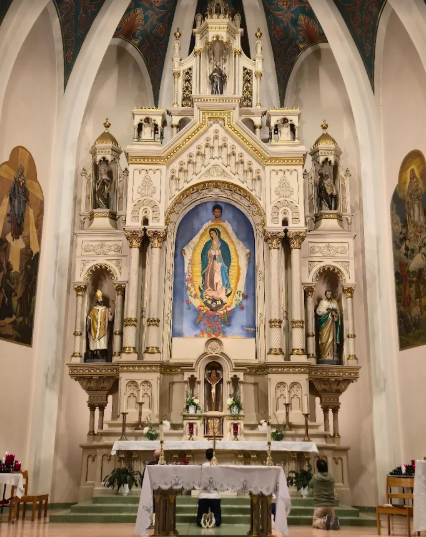
The Archdiocese of Chicago reported that Father Jose Molina, IVE, was removed from ministry following allegations of improper and inappropriate communications with minors and adult women. The case raises serious questions about the institutional model of the Institute of the Incarnate Word: its lack of psychological filtering, its culture of expansion, the loneliness of many of its priests and the way in which the institute seeks episcopal support to defend itself before Rome.
The Archdiocese of Chicago said Father Jose Molina, a priest at the Institute of the Incarnate Word, was removed from ministry after receiving allegations that he had “improper and inappropriate conversations and communications” with minors and adult women.
The information was communicated by Cardinal Blase Cupich in a letter dated May 9, 2026 and addressed to the faithful of St. Francis of Assisi Parish in Chicago, where the priest had been serving as a temporary minister since August 2025.
According to the archbishop’s letter, Father Molina was stripped of his faculties to minister in the Archdiocese of Chicago. In addition, since he belongs to the Institute of the Incarnate Word, he was sent back to the provincial house of that congregation, which, according to the same letter, is responsible for his ministry in the Church.
The archdiocese also indicated that the allegations were reported to civil authorities and that the complainants received the offer of assistance from the corresponding archdiocesan office.
The news was published by EWTN News, and the official letter from the Archdiocese of Chicago can be found on the archdiocese’s website.
It is important to be precise: for the moment these are accusations, not a definitive criminal or canonical conviction. But the case cannot be treated as a simple isolated incident. The central element here is that the priest belongs to the IVE, a religious institute that for years has been dragging serious questions about its internal culture, its mode of government, the training of its members and the way in which it responds to complaints, abuses of authority or problematic behavior.
The problem is not only José Molina
When an IVE priest is removed from ministry for allegations involving inappropriate communications with minors and adult women, the question cannot be limited to that priest’s individual conduct. The underlying question is institutional:
What real mechanisms does the IVE have to evaluate, supervise and correct its members?
Father Molina was not a diocesan priest acting on his own. He was a member of an international religious congregation. He had been sent to serve temporarily in a Chicago parish. This implies a chain of responsibility: training, selection, sending, accompaniment, control and eventual correction.
Cardinal Cupich’s letter is significant because it expressly states that, as an IVE priest, Molina returned to the provincial house of the congregation, responsible for his ministry in the Church. That phrase must be read carefully. This is not a purely local Chicago problem. We are dealing with an IVE priest whose conduct has provoked a public intervention by an American archdiocese.
The worrying pattern: mobility, opacity and diffuse responsibility
One of the great difficulties with international congregations such as the IVE is the mobility of its members. Priests and religious can move from one country to another, from one community to another, from one diocese to another, and many times the faithful do not know the complete history of those who come to serve in their parishes, schools, missions or communities.
This case raises an inevitable question:
What did the IVE know about Father José Molina before sending him to Chicago?
I am not claiming that the congregation was previously aware of problematic behavior. We don’t have public elements to say that. But precisely for this reason the question must be asked publicly. If there was no record, what preventive controls were in place? If there were, why was it sent anyway? If the allegations surfaced during his ministry in Chicago, how did the IVE act before and after being informed?
The underlying problem is diffuse responsibility. The diocese can withdraw faculties. The religious institute can transfer the priest. Civil authorities can investigate. But the faithful are often left without knowing who is really responsible for the whole system that allowed that person to be in pastoral contact with minors and adult women.
The absence of a true psychological filtering in the IVE
Another element that must be seriously examined is the process of admission and formation within the Institute of the Incarnate Word. Unlike what happens today in most seminaries and religious congregations in the world, where there are increasingly strict psychological evaluations, professional interviews and criteria of human discernment, abortion has been characterized by a serious shortcoming: the absence of a true psychological filter upon admission.
This point is fundamental. The priestly or religious vocation cannot be evaluated solely on the basis of enthusiasm, external discipline, doctrinal adherence or willingness to obey. Affective maturity, relational capacity, emotional stability, relationship with authority, integration of sexuality, ability to live in community and aptitude to exercise pastoral ministry with vulnerable people should also be evaluated.
When a congregation does not engage in serious psychological discernment, it increases the risk that people who do not have the maturity to exercise spiritual authority over others will enter, remain, or be ordained. This does not mean that every person with psychological frailties is dangerous. It means something more concrete: an institution that trains priests has the duty to know, accompany and, when necessary, stop vocational processes that can end up causing harm.
In this sense, the case of Father José Molina, IVE, should open a broader question: what kind of human, affective, and psychological evaluation did he receive before being ordained and before being sent to minister in a Chicago parish? What criteria does the IVE use to admit candidates, ordain them and send them to communities where they will have pastoral contact with minors, adult women, families and spiritually dependent people?
These questions are not intended to diagnose a specific person or replace research. But they do point to a structural weakness: without serious psychological filters, without external controls, and without a real culture of human discernment, a congregation can be transformed into a space where obedience and the appearance of orthodoxy outweigh inner maturity.
The loneliness of many priests of the IVE
To this problem is added another aspect that is little mentioned: the loneliness in which many priests of the Institute of the Incarnate Word live. Although the IVE presents itself as a religious and missionary family, in practice many of its priests are sent to destinations where they live alone or almost alone, sometimes only with another priest. In many cases, this other priest also functions as a local superior, which prevents a true relationship of brotherhood.
Religious life should not be reduced to sharing a home or a pastoral agenda. Religious life implies fraternity, mutual correction, accompaniment, common rest, sincere conversation, human balance and a daily network of bonds that help the priest not to close in on himself. When a priest lives alone, or lives with a single companion who also exercises authority over him, this fraternal dimension is gravely impoverished.
This loneliness is not a secondary detail. An isolated priest, subjected to a heavy pastoral burden, without real horizontal bonds, without spaces of trust and without balanced adult supervision, can become more vulnerable to disordered affective compensations, ambiguous relationships or emotional dependencies with people whom he should accompany pastorally with distance and prudence.
The problem, therefore, is not only moral. It is also structural. A congregation that sends priests alone or almost alone to different countries and dioceses must ask itself whether it is really offering a healthy religious life or if, in practice, it is using its members as functional pieces to cover missions, parishes and apostolates.
In the case of IVE, this question is especially important because the institute insists a lot on missionary availability, obedience and sacrifice. But missionary availability cannot justify conditions of life that destroy religious fraternity. And obedience cannot replace the basic human need for healthy bonds, real accompaniment and balanced community life.
That is why, when analyzing the Molina case, it is not enough to ask what a specific priest did or did not do. It is also necessary to ask in what kind of human and community structure he was formed, accompanied and sent. If the IVE does not have adequate psychological filters and also sends its priests to live in situations of isolation, then the problem cannot be reduced to an individual failure. We are facing a much deeper institutional vulnerability, also linked to an expansion strategy that seeks to multiply episcopal support before the Vatican.
Multiplying presences to multiply intercessory bishops
From the outside, the international expansion of the IVE may seem simply a sign of missionary vitality. But those of us who have lived the logic of the institute from within know that the multiplication of presences also has a political and ecclesiastical dimension.
The IVE seeks to multiply presences in dioceses, countries and parishes not only for pastoral reasons, but also to multiply the number of bishops who can intercede for the institute before the Vatican. The logic is simple: the more bishops receive priests from the IVE, the more likely the institute is to have defenders when Rome considers harsh measures against the congregation.
This strategy becomes especially important when the IVE interprets the criticisms, interventions or investigations of the Holy See as the fruit of the influence of “progressive” sectors within the Church. In that frame of mind, the problem is never really within the institute: it would always come from external enemies, from opposing ideologies, from ill-informed bishops, or from Roman officials supposedly hostile to a congregation “faithful to doctrine.”
Thus, territorial expansion does not function only as a mission. It also functions as an institutional survival mechanism. Each new presence can become a useful relationship. Each diocese can become a possible point of support. Every bishop satisfied with available, conservative and obedient priests can become, when the time comes, a favorable voice before Rome.
The problem is that this strategy has a very concrete human cost: priests sent alone or almost alone, minimal communities, lack of real fraternal life, direct dependence on the superior, affective isolation and absence of horizontal controls. What is presented externally as missionary zeal, inwardly can become a functional dispersion of the institution’s power.
In other words, the loneliness of many priests of the IVE is not only an accidental consequence of the mission. It is also the result of a policy of expansion that prioritizes institutional presence over healthy religious life. Houses, parishes, chaplaincies and destinations are multiplying, but a true religious community is not always guaranteed.
This is very serious. Because if a congregation sacrifices the fraternal life of its members to gain ecclesiastical influence, then it stops treating its priests as people called to live a community vocation and begins to treat them as available pieces within a corporate survival strategy.
From this perspective, the case of Father José Molina, IVE, must also be read within a broader structure. It is not enough to ask what a particular priest did or did not do. It is also necessary to ask what type of institution forms, sends and accompanies its priests; what place the psychological and affective health of these priests occupies; and whether the expansion of the IVE has not been built, in part, at the expense of the loneliness and vulnerability of its own members.
“Inappropriate communications” are not a minor detail
Some might minimize the case by saying that the letter does not speak of consummated sexual abuse, but of inappropriate conversations and communications. That distinction is important and must be respected. But it does not make the case secondary.
In pastoral contexts, especially when minors are involved, private communications can be the first space where boundaries are crossed. Ambiguous messages, conversations of affective content, mishandled spiritual direction, emotional dependence, manipulation of conscience or improper familiarity can become forms of abuse of power, even before any physical contact.
Therefore, when an archdiocese considers allegations serious enough to withdraw a priest’s ministerial faculties and report them to the civil authorities, the fact must be taken extremely seriously.
The IVE must respond publicly
The Institute of the Incarnate Word should not just take the priest back and handle the case internally. Opacity is precisely one of the causes of the loss of trust.
The IVE should clearly answer basic questions:
- Since when did the congregation know of the accusations against Father José Molina?
- Were there any previous antecedents or previous complaints?
- What evaluation was made before sending it to St. Francis of Assisi Parish?
- What concrete measures did the IVE take after receiving the information?
- Will the internal investigation be publicly communicated?
- Will other communities where the priest has previously served be contacted?
- What kind of psychological filtering did the priest have during his admission, formation, and ordination?
- In what concrete community conditions did he live and exercise his ministry?
These questions do not constitute an anticipated condemnation. These are minimum requirements of institutional transparency.
A religious institute that purports to train priests, educate young people, spiritually lead families, and send missionaries around the world must accept a serious level of accountability. Religious obedience cannot function as a barrier against external scrutiny.
A case that confirms the need to look at abortion as a system
The Molina case must be read within a broader context: the IVE is not simply a congregation with some individual problems. It is an international structure with a strong internal culture, a very marked doctrinal identity, an intense relationship between authority and obedience, and a history of questioning its founder, its government and its practices.
Therefore, each new case involving a member of the institute must be analyzed not only as “an accused priest,” but as one more piece in a larger question:
Does the IVE have an institutional culture capable of preventing abuses, listening to complaints, correcting its members and making their mistakes transparent?
The experience of many victims in religious institutions shows that abuse does not thrive solely on the conduct of deviant individuals. They thrive when there is a system that silences, minimizes, displaces, protects reputations, or subordinates the truth to the preservation of the work.
In the case of the IVE, this question is made even more serious by the combination of several factors: lack of serious psychological filtering, top-down obedience, international mobility, minimal communities, isolated priests, superiority exercised within very close relationships, and a policy of expansion that can prioritize institutional presence over the human health of its own members.
The responsibility of the dioceses that receive priests from the IVE
This case should also serve as a warning to dioceses that receive priests from the Institute of the Incarnate Word. It is not enough to accept clergy available to cover parishes, chaplaincies or missions. Dioceses have a duty to demand complete information, clear background and verifiable assurances.
The Archdiocese of Chicago acted by withdrawing Father Molina’s ministerial faculties, informing the parish community, reporting the allegations to civil authorities, and referring the case to the IVE’s area of responsibility. But the broader question remains open: how many dioceses really know the internal situation of the IVE before accepting its members?
Dioceses should not solely evaluate whether an IVE priest is doctrinally conservative, obedient, available, or helpful to meet a pastoral need. They should also ask themselves about their human formation, their affective maturity, their community history, their psychological accompaniment and the real conditions in which they live.
Receiving priests from a questioned congregation requires more prudence, not less. Pastoral availability cannot become an alibi for ignoring structural problems.
Conclusion: it is not an isolated case, it is an institutional warning
Father José Molina, IVE, has the right to a fair trial and not to be found guilty before the investigation is over. But potential victims also have the right to be heard, protected, and taken seriously. And the faithful have the right to know how the Institute of the Incarnate Word acts when one of its priests is accused of inappropriate behavior with minors and adult women.
This case should not be used to make an irresponsible accusation. But neither should it be buried under the usual language of internal investigations, discreet transfers and institutional formulas.
The central question is simple:
What will the IVE do with this case?
Will you treat it as an isolated problem that needs to be contained? Or will it accept that each new scandal confirms the need for a profound review of its culture, its government and its control mechanisms?
The problem is not just that some priests may fail. The problem is that the IVE has built an institutional model where expansion, obedience and corporate defense weigh more than psychological discernment, real fraternal life and transparency before the faithful.
For those who have closely followed the history of the Institute of the Incarnate Word and of the Servants of the Lord and of the Virgin of Matará, this new episode cannot go unnoticed. It is one more sign that the problem is not only in certain people. It is also in a system that must be examined with rigor, transparency and courage: its admission criteria, its lack of psychological filtering, its obedience model, its supervisory mechanisms, its policy of expansion and the real conditions of solitude in which many IVE priests exercise their ministry.


Leave a Reply