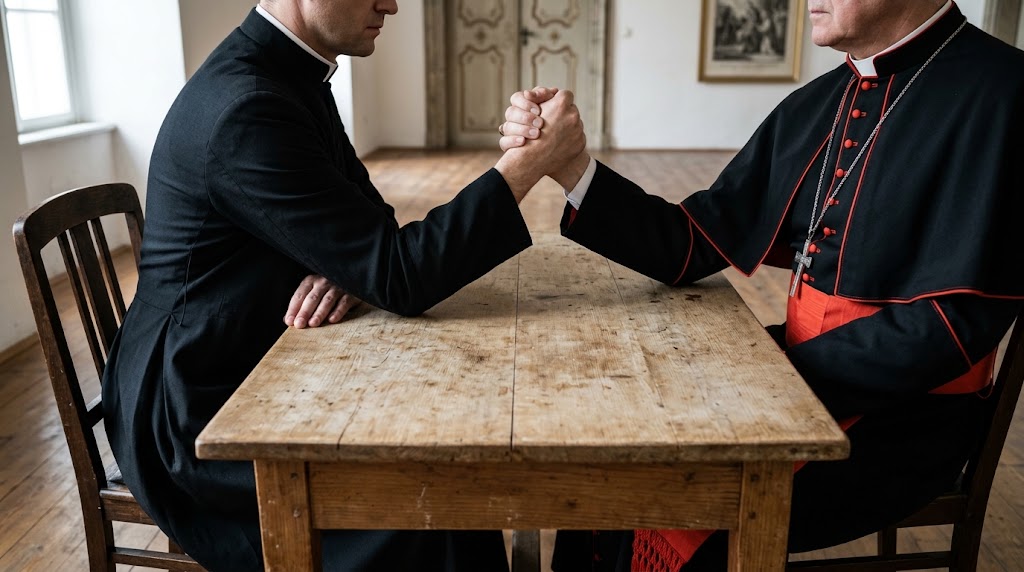
The Institute of the Incarnate Word has released this statement in response to the decision taken this week by the Holy See regarding the Institute, the Servants and the memory of its founder, Father Carlos Buela. We publish the full text below.
We absolutely reject all types of abuse
We, the Major Superiors of the Institute of the Incarnate Word, interpreting the common sentiment of the members of the Institute, profess and assume in its entirety the moral doctrine of the Church and, consequently, condemn and reject without any ambiguity all forms of abuse, sexual abuse, manipulation, violence, harassment or disorderly sexual conduct, especially when it is carried out by those who are constituted in authority and against persons entrusted to their care or who are in a situation of special vulnerability.
We also reject any falsification, instrumentalization or distorted interpretation of friendship, affection and personal relationships. True friendship cannot be based on the use of the other or on the disordered search for oneself, but must be founded on Christian charity, which, as Saint Paul teaches, is “the bond of perfection” (Col 3:14).
Any relationship of friendship, trust, accompaniment or spiritual fatherhood must always respect the dignity of the person, chastity, prudence and the limits proper to each state and relationship.
We repudiate, therefore, all sexual disorders and all conduct that violates the dignity and integrity of the person, and we are fully ready to collaborate with the Church in the face of any conduct that truly constitutes abuse, always in accordance with truth, justice, law and the procedures established by the Church. And we affirm the same with regard to the attention and care of victims of abuse.
We do not pass judgment on the guilt or innocence of the Founder
We do not know the accusations made against the Founder in their entirety or in all their details, nor have we been and are not judges of the facts attributed to him. For this reason, we do not affirm the guilt of Fr. Carlos Buela with respect to the acts for which he was accused, but neither do we intend to declare his innocence.
In the same way, it is not for us to determine whether or not the facts attributed constituted canonical crimes.
We affirm that the criminal judicial process could not reach its conclusion and the presumption of innocence remains legally
Bearing in mind that the criminal proceedings were not concluded because of the death of the accused, it is not for the Institute to formulate a judgment of guilt on the Founder or to consider that a process that did not reach its conclusion has been legally concluded.
For this reason, we abide by the legal consequences of an inconclusive criminal process and reject that the Founder can be presented as legally convicted by virtue of a process that was not concluded.
We also believe that the dissemination of accusations or conclusions of guilt with respect to a deceased person must be subject to the requirements of the law and, in particular, to respect for his or her good reputation.
In fact, the Dicastery for Legislative Texts, in a letter dated January 29, 2026 (Prot. N. 18838/2026), responded to a query on this same case, stating that, considering the death of the accused before the conclusion of the judicial process, the presumption of innocence remains, as evidenced and made explicit in the new can. 1321 of the CIC.
He also pointed out that it is not lawful to give public notice now of a sentence that has not passed in iudicato, precisely because, as long as the sentence is not final, the presumption of innocence remains.
See also the response of the Dicastery for Legislative Texts, No. 18316/2024, of September 5, 2024, on the good reputation of the deceased.
In addition, can. 1614 establishes that “the judgment must be published as soon as possible, indicating in what ways it can be challenged; and it does not produce any effect before its publication, even if the operative part has been notified to the parties, with the permission of the judge.”
In this case, the accused was not even notified of a device. It is recorded, however, that the proceedings were archived by the judge by decree, without a device being notified and without the sentence being drafted.
In the same vein, the Supreme Tribunal of the Apostolic Signatura (Prot. n. 57824/25 CA, Decree of May 29, 2026) pronounced itself, suspending, as illegitimate, the execution of the mandate given by the Pontifical Delegate for the Institute “Servants of the Lord and of the Virgin of Matará”.
The Pontifical Delegate had ordered that a note be published on the website of the Pontifical Institute, dated January 12, 2025, which stated: “The pontifical delegate is entrusted in a particular way with the renewal of the formation itineraries, the reform of proper law, as well as the transparent communication to all members about the crimes committed by the Founder of both Institutes, Fr. Carlos Buela.”
Therefore, we consider it illegitimate to communicate to the members of both Institutes the guilt of the Founder as a legally established fact, and equally illegitimate we consider to present as concluded or definitive the results of a criminal process that did not reach its conclusion.
Pope Francis himself, moreover, wrote an autograph letter on August 16, 2023 to a member of the Institute saying that “they were very concerned to know the final ‘sentence’… but there was no sentence. Things of clericalism.”
The Pontiff himself explicitly expressed his desire that, with the death of the Founder, the case be closed and archived and that the subject should not be spoken of anymore.
We recognize and accept the decisions of the Holy See
We accept and abide, in a spirit of faith, fidelity and religious obedience, the dispositions that the Holy See legitimately adopts with respect to the Founder, his memory and the consequences that derive from it for the life of the Institute, as well as the concrete obligations that are legitimately imposed on us, even if we personally do not share certain judgments or evaluations that may accompany them.
We are ready to fulfill them as soon as this is compatible with the obligations and limits proper to virtue and the vow of obedience.
We do not recognize the Founder as a saint, nor has the Institute ever maintained such an affirmation
For us, the “saints”, whom we venerate with the cult of dulia, are only those who have been declared as such by the legitimate authority of the Church.
The fact that the members of the Institute have and express personal feelings towards the Founder, whether favourable or unfavourable, belongs to the sphere of conscience and personal freedom of each religious, and the Institute does not and cannot claim to be the judge of the conscience of its members (cf. can. 630, § 5).
We want to defend, promote and live the charism received through the Founder
With regard to the work of the Founder, the good he has done, and especially the spiritual, doctrinal, apostolic and formative patrimony that has been received and recognized by the Church – that is, everything that has to do with the mind and purposes of the Founder (can. 578) as such – we must and want to defend it, promote it and live it.
We do not recognize that a relationship can be established between the possible personal guilt of the Founder in certain events and the authenticity of the charism of the Institute.
It is necessary to distinguish between the person of the Founder, his possible personal faults, and his own foundational charism, which the Church has already discerned, approved and received as a gift for the whole Church.
For this reason, we consider that any judgment on the current reality of the Institute or on the fidelity with which it is living its charism must be made separately, with its own criteria and through an objective examination of its fruits, its life and its mission in the Church.


Leave a Reply